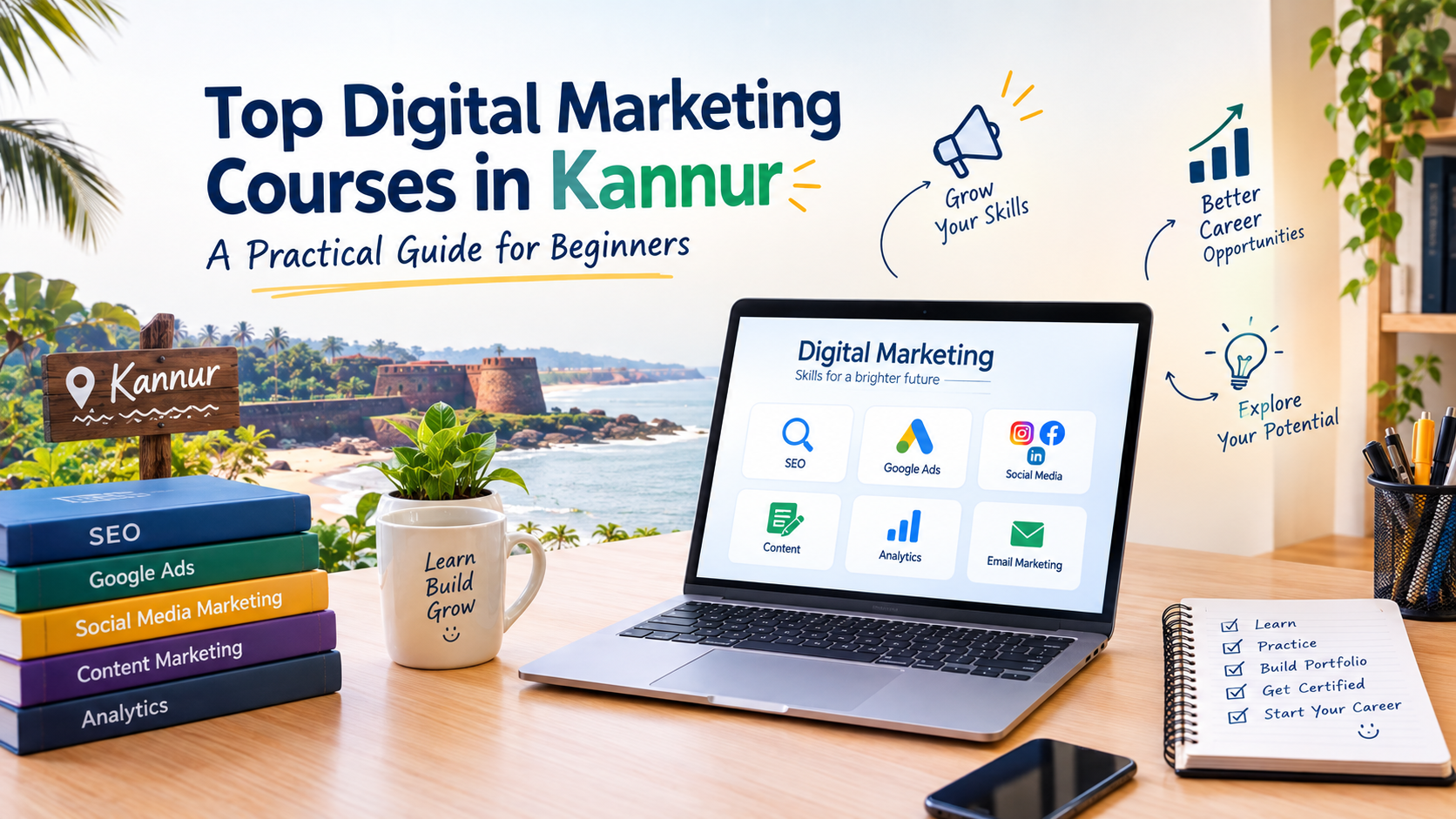
Top Digital Marketing Courses in Kannur: A Beginner’s Roadmap to Skills and Careers
Sep 21, 2026
Choosing a digital marketing course can feel confusing when every course seems to promise the same things: SEO, social media, Google Ads, certification, and career opportunities.
For students and professionals in Kannur, the better approach is to look beyond advertisements and understand what you will actually learn, how those skills are practised, and where they can be applied.
If you are searching for Top digital marketing courses in Kannur, this guide can help you understand the learning options, important skills, practical training requirements, and career paths available in digital marketing.
Why Are People in Kannur Learning Digital Marketing?
Digital platforms have changed how businesses communicate with customers.
A local business can now reach customers through Google Search, Instagram, Facebook, YouTube, websites, email, and online advertisements. Even a small business can create an online presence without depending entirely on traditional advertising.
This has also created demand for people who can manage digital marketing activities.
For learners, this makes digital marketing an interesting skill to explore because it combines several areas:
- Marketing
- Communication
- Creativity
- Technology
- Data analysis
- Consumer behaviour
You do not necessarily have to be an expert in all of these areas from the beginning.
What Does a Digital Marketing Course Actually Teach?
A digital marketing course is usually a collection of several different subjects rather than one single skill.
The learning journey may include the following areas.
Search Engine Optimization
SEO helps websites become more visible when people search for information, products, or services.
A beginner may learn:
- Keyword research
- Search intent
- On-page optimisation
- Technical SEO
- Off-page SEO
- Local SEO
- Link building
- SEO audits
- Search performance analysis
For example, a local business in Kannur may want its website to appear when someone searches for a service available in the area. Local SEO can be used as part of that strategy.
Social Media Strategy
Social media marketing goes beyond uploading photographs or promotional posts.
A learner may explore:
- Audience research
- Content planning
- Social media calendars
- Reels and short-form content
- Engagement strategies
- Paid social campaigns
- Performance measurement
The important skill is understanding why particular content is created and who it is intended for.
Google Ads and Paid Campaigns
Paid advertising allows businesses to reach audiences based on factors such as search queries, interests, demographics, and online behaviour.
Coursework may introduce:
- Search campaigns
- Display campaigns
- Keyword selection
- Ad copy
- Bidding
- Conversion tracking
- Campaign optimisation
- Budget management
Students can also learn how metrics such as CPC, CTR, conversion rate, CPA, and ROAS are interpreted.
Content Marketing
Content is an important part of modern digital marketing.
Instead of only promoting a product, businesses can publish information that answers questions their potential customers are already asking.
Content may include:
- Blog posts
- Guides
- Videos
- Social media posts
- Infographics
- Case studies
- Email newsletters
For someone learning digital marketing, content creation also provides an opportunity to develop writing and communication skills.
Analytics and Reporting
Digital marketing generates a large amount of data.
A campaign report might show:
- Number of users reached
- Website visits
- Clicks
- Leads
- Purchases
- Advertising costs
- Conversion rates
Learning how to interpret this information is important because marketers need to understand what happened and identify possible areas for improvement.
Practical Training Matters More Than Memorising Definitions
One common problem beginners face is learning digital marketing only through theory.
Knowing that SEO means "Search Engine Optimization" does not automatically mean you know how to optimise a website.
Similarly, knowing the definition of CPC does not mean you can manage a successful advertising campaign.
A practical learning programme may allow students to work on activities such as:
Keyword research → Website optimisation → Content creation → Campaign setup → Performance tracking → Reporting
This gives learners an opportunity to understand how different digital marketing activities connect.
What Kind of Projects Can Students Practise?
A good way to understand a course is to look at the projects included in the learning process.
For example, a beginner could practise by creating a digital marketing plan for:
- A local restaurant
- A clothing store
- A healthcare service
- An educational institution
- A tourism business
- A beauty brand
- An online store
A project could include keyword research, competitor analysis, social media planning, SEO recommendations, sample advertisements, and a basic performance report.
These projects can later become part of a personal portfolio.
How to Compare Digital Marketing Courses in Kannur
There is no universal definition of the "top" course because different learners have different requirements.
Instead, compare programmes using practical criteria.
1. Course Curriculum
Look at the complete syllabus rather than just the course title.
Check whether the programme covers the areas you want to learn.
2. Practical Assignments
Ask whether students actually work on projects or only attend lectures.
Hands-on work can make it easier to understand digital marketing concepts.
3. Tools and Platforms
Digital marketers work with different platforms and tools.
Depending on the course, learners may get exposure to:
- Google Search Console
- Google Analytics
- Google Ads
- Meta Ads Manager
- SEO tools
- Keyword research platforms
- Content creation tools
The exact tools can vary as platforms continue to evolve.
4. Portfolio Development
A certificate shows that you completed a programme. A portfolio can demonstrate what you can actually do.
A beginner portfolio could contain:
- SEO audit
- Keyword research report
- Social media calendar
- Sample Google Ads campaign
- Content strategy
- Competitor analysis
- Analytics report
5. Learning Support
Digital marketing often involves troubleshooting.
For example, a website may not be ranking, an advertisement may have a high CPC, or a landing page may have a low conversion rate.
Access to feedback while practising can help learners understand how to approach such problems.
Can Students From Any Background Learn Digital Marketing?
Digital marketing is not restricted to students from one particular academic stream.
Learners can come from:
- Computer applications
- Commerce
- Management
- Arts
- Science
- Engineering
- Design
- Other academic backgrounds
The skills required can vary depending on the role.
For example, an SEO role may involve more analytical work, while content marketing may involve more writing and communication.
Digital Marketing Career Paths
Digital marketing includes several specialisations.
SEO Executive
Focuses on improving organic search visibility through keyword research, content optimisation, technical SEO, and link-building activities.
Social Media Executive
Works on social media content, publishing schedules, engagement, audience research, and social media campaigns.
Performance Marketing Executive
Works primarily with paid advertising and campaign performance.
Content Marketing Executive
Creates and manages useful content for websites, blogs, social media, and other digital channels.
PPC Executive
Focuses on paid search campaigns, keyword targeting, advertisements, bidding, and optimisation.
Digital Marketing Executive
May handle multiple areas of digital marketing, particularly in smaller organisations where one person manages several channels.
Is a Digital Marketing Course Enough to Get a Job?
A course can provide foundational knowledge, but completing a course alone does not guarantee employment.
Employers may also look at:
- Practical skills
- Portfolio projects
- Communication
- Analytical thinking
- Familiarity with marketing tools
- Ability to understand campaign data
- Problem-solving
- Willingness to learn
For beginners, building small projects while learning can therefore be useful.
How Can Beginners Build a Digital Marketing Portfolio?
You do not always need a large company project to start building a portfolio.
You can create sample projects based on hypothetical businesses.
For example:
Project 1: SEO audit for a local business
Project 2: 30-day Instagram content calendar
Project 3: Google Ads campaign structure for a service business
Project 4: Keyword research report
Project 5: Competitor analysis
Project 6: Landing page improvement suggestions
These projects can demonstrate your understanding of different digital marketing activities.
Digital Marketing Learning in Kannur: Offline or Online?
Both learning formats have their own characteristics.
Offline Learning
Classroom learning may provide:
- Direct interaction with trainers
- Classroom discussions
- Group activities
- Scheduled learning
- Face-to-face feedback
This format may suit learners who prefer structured classroom environments.
Online Learning
Online programmes may provide:
- Flexible schedules
- Remote access
- Recorded lessons
- Learning from different locations
- Self-paced study
The more important factor is whether the course provides opportunities to practise.
Frequently Asked Questions
What should I look for when searching for Top digital marketing cources in Kannur?
Look at the curriculum, practical assignments, tools covered, project work, trainer support, course duration, learning format, and portfolio opportunities. Comparing these factors is more useful than choosing based only on promotional claims.
Which digital marketing skill should a beginner learn first?
Start with marketing fundamentals and then build an understanding of SEO, content, social media, paid advertising, and analytics. You can later specialise in the area that matches your interests.
Is digital marketing suitable for BCA graduates?
Yes. BCA graduates can explore digital marketing because many areas do not require advanced programming. Technical knowledge can also be useful in areas such as technical SEO, analytics, websites, and marketing technology.
Do digital marketing courses include real projects?
This depends on the individual programme. Before enrolling, check whether projects are part of the curriculum and whether students receive feedback on their work.
Is certification important in digital marketing?
Certification can document course completion, but practical skills and demonstrable work are also important. A portfolio can help show how you apply what you have learned.
Can I learn digital marketing without coding?
Yes. Many digital marketing areas can be learned without advanced coding, including SEO fundamentals, social media marketing, content marketing, email marketing, and paid advertising.
How can I practise digital marketing as a beginner?
You can create sample campaigns, perform SEO audits, conduct keyword research, prepare content calendars, analyse competitors, and build small portfolio projects.
A Simple Roadmap for Beginners
If you are starting from zero, you do not need to learn everything simultaneously.
A practical roadmap could look like this:
Month 1: Marketing fundamentals + SEO basics
Month 2: Content + social media marketing
Month 3: Google Ads + paid social advertising
Month 4: Analytics + reporting + practical projects
After that: Choose a specialisation and continue building your portfolio.
The actual time required depends on your learning schedule and the depth at which you want to study each topic.
Final Takeaway
Searching for Top digital marketing courses in Kannur is only the first step. The more important question is whether a particular course helps you develop skills that you can actually apply.
Look for a programme that balances theory with practical assignments, introduces relevant tools, provides project experience, and gives you enough opportunity to understand how digital campaigns work.
Digital marketing is a broad field, so beginners do not have to master every area immediately. Start with the fundamentals, practise regularly, explore different specialisations, and gradually build a portfolio that demonstrates your skills.
Talk to Our Career Expert
Unbiased Career Guidance
Have questions after reading this? Book a free call and our counselors will guide you.
© 2026 DigitalMarketingCourseKerala.com
Need Course Guidance?
Talk to our expert