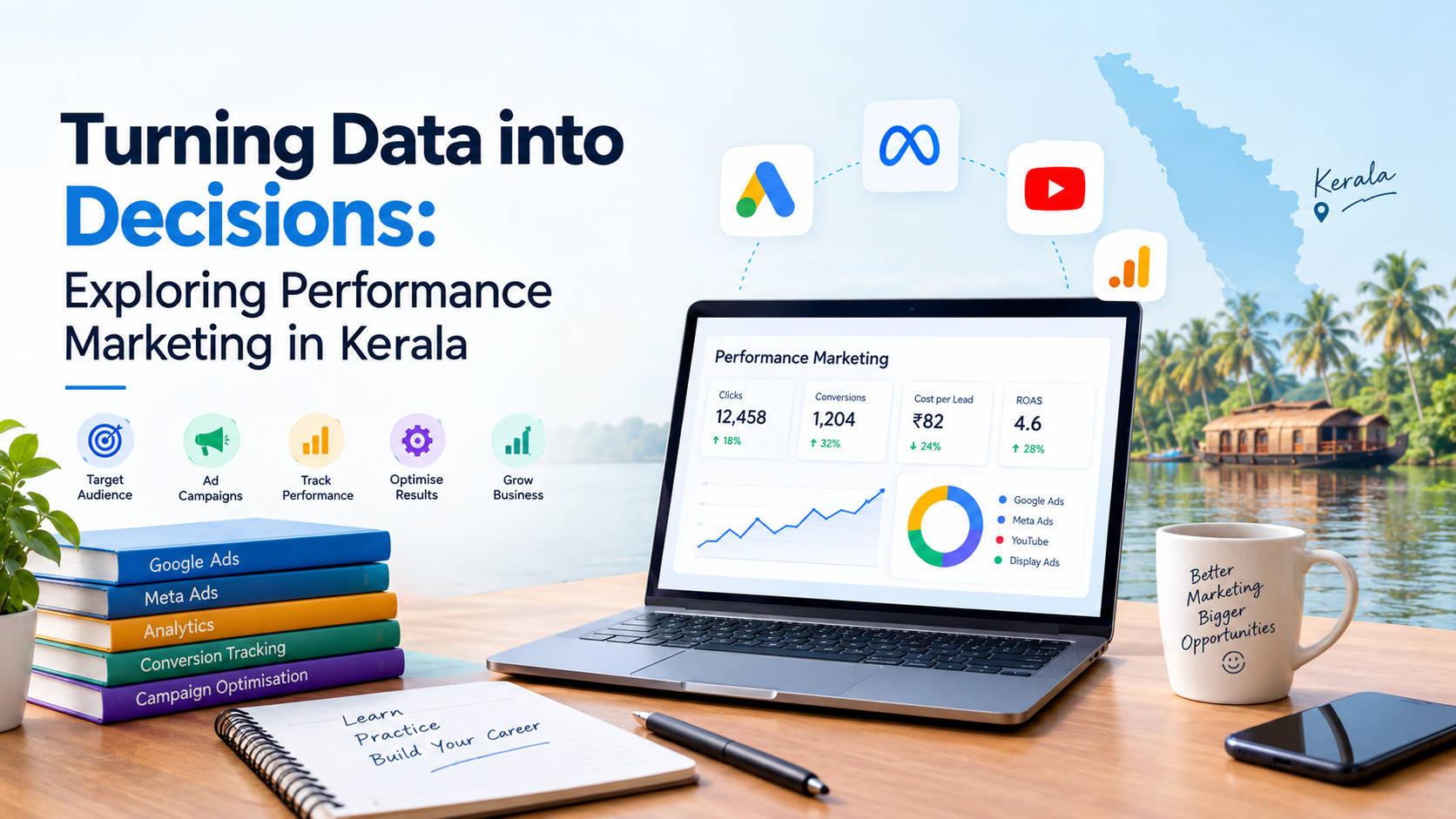
Turning Data into Decisions: Exploring Performance Marketing in Kerala
Oct 01, 2026
Digital marketing has moved beyond simply getting people to notice a brand. Today, businesses want to understand what happens after someone sees an advertisement, clicks a link, visits a website, fills out a form, or makes a purchase.
This is where performance marketing becomes important.
Performance marketing uses measurable data to understand how digital campaigns are performing and where improvements can be made. Instead of looking only at visibility or reach, marketers examine metrics such as clicks, leads, conversions, acquisition costs, and revenue.
For students, graduates, marketers, and business owners exploring performance marketing courses in Kerala, understanding this data-driven approach is a useful starting point. Before choosing a course, it helps to know what performance marketing involves, which skills are required, and how these skills are applied in real campaigns.
What Is Performance Marketing?
Performance marketing is a digital marketing approach that focuses on measurable actions and outcomes.
These actions can include:
- Website visits
- Lead generation
- Product purchases
- App installations
- Registrations
- Phone calls
- Enquiries
- Subscriptions
For example, imagine an online business spends ₹20,000 on an advertising campaign.
Simply knowing that the advertisement received 50,000 impressions does not explain whether the campaign was useful to the business.
A performance marketer may instead examine:
₹20,000 spent → 2,000 clicks → 150 leads → 30 customers → ₹80,000 revenue
This type of analysis helps connect advertising activity with business outcomes.
Why Does Data Matter in Performance Marketing?
Data provides marketers with information that can support campaign decisions.
Suppose one advertisement receives more clicks than another. That may initially appear positive.
But if the second advertisement generates more qualified leads at a lower cost, the numbers tell a different story.
This is why performance marketing involves looking beyond individual metrics.
Marketers may ask:
- Which audience is responding?
- Which advertisement is generating conversions?
- Which keyword is bringing relevant traffic?
- How much does each lead cost?
- Which campaign generates better revenue?
- Where are users dropping out?
- Is the landing page converting visitors?
The answers can help guide campaign optimisation.
How Is Performance Marketing Different from Digital Marketing?
Digital marketing is a broad field that includes many online activities.
These can include:
- SEO
- Social media marketing
- Content marketing
- Email marketing
- Influencer marketing
- Search advertising
- Display advertising
- Analytics
Performance marketing is more strongly focused on measurable campaign outcomes.
For example:
SEO: Improve organic search visibility.
Social media marketing: Build engagement and audience relationships.
Performance marketing: Measure paid campaign activity against defined actions or business outcomes.
These areas can overlap. A performance marketer may work with SEO, social media, analytics, landing pages, and content as part of a broader strategy.
What Are the Main Performance Marketing Channels?
Performance marketing is not limited to one advertising platform.
Google Ads
Google Ads can help businesses reach users who are actively searching for products, services, or information.
Depending on the campaign, marketers may work with:
- Search Ads
- Display Ads
- Video Ads
- Shopping Ads
- App campaigns
- Performance Max
Search advertising is particularly relevant when user intent is clear.
For example, someone searching for “best digital marketing course in Kerala” may have a different intent from someone searching for “what is digital marketing?”
Understanding that difference is important when building campaigns.
Meta Ads
Facebook and Instagram advertising can be used to reach audiences based on different targeting signals.
Performance campaigns on Meta may focus on:
- Leads
- Sales
- Website traffic
- Engagement
- App activity
- Remarketing
Creative testing and audience analysis are important parts of managing these campaigns.
YouTube Advertising
Video advertising can be used for awareness as well as measurable campaign objectives.
Marketers can analyse metrics such as views, interactions, clicks, and conversions depending on the campaign setup.
Display Advertising
Display campaigns can help businesses reach relevant audiences across websites and digital properties.
They may be used for awareness, remarketing, or other campaign objectives.
What Do You Learn in Performance Marketing Courses in Kerala?
The syllabus can vary between training providers, but a well-rounded programme may cover several important areas.
Performance Marketing Fundamentals
Beginners first need to understand concepts such as:
- Campaign objectives
- Target audiences
- Advertising platforms
- Budgets
- Bidding
- Conversion goals
- Customer journeys
These concepts provide the foundation for platform-specific learning.
Audience Research
A campaign becomes more meaningful when the marketer understands who the intended audience is.
Learners may explore:
- Buyer personas
- Demographics
- Interests
- Behaviours
- Search intent
- Customer segments
- Purchase journeys
Audience research can influence both campaign targeting and creative strategy.
Keyword Research
For search advertising, keywords are a major part of campaign planning.
Students may learn about:
- Search intent
- Short-tail keywords
- Long-tail keywords
- Match types
- Negative keywords
- Commercial intent
The goal is not simply to choose keywords with high search volume. Relevance to the business objective is equally important.
Campaign Setup
Practical performance marketing training may include creating campaigns from the beginning.
This can involve:
Objective → Audience → Budget → Ad group/ad set → Creative → Landing page → Tracking → Optimisation
Understanding this complete process can be more useful than learning isolated platform features.
Important Performance Marketing Metrics
Data is at the centre of performance marketing, so learners need to understand common metrics.
CPC — Cost Per Click
CPC shows the average amount paid for each click.
CTR — Click-Through Rate
CTR indicates how frequently people click an advertisement after seeing it.
CPM — Cost Per Thousand Impressions
CPM measures the cost of generating one thousand impressions.
CPL — Cost Per Lead
CPL shows the average advertising cost associated with generating a lead.
CPA — Cost Per Acquisition
CPA measures the cost associated with acquiring a customer or another defined conversion.
Conversion Rate
Conversion rate indicates how frequently users complete the desired action.
ROAS — Return on Ad Spend
ROAS compares attributed revenue with advertising expenditure.
For example, if ₹10,000 is spent and the campaign generates ₹40,000 in attributed revenue:
ROAS = 4
However, no single metric should automatically be treated as the complete measure of campaign success. The relevant metric depends on the business model and campaign objective.
Why Conversion Tracking Is Important
A marketer cannot make reliable decisions if important actions are not being measured correctly.
Conversion tracking can help identify actions such as:
- Purchases
- Form submissions
- Phone calls
- Registrations
- Downloads
- App actions
Tools and technologies used in this area may include Google Analytics, Google Tag Manager, advertising-platform tracking systems, and other measurement solutions.
Understanding tracking is therefore an important part of learning performance marketing.
The Role of Landing Pages
Imagine clicking an advertisement for a particular service and arriving on a homepage that contains unrelated information.
The visitor may leave without taking action.
This is why performance marketing is connected to landing-page optimisation.
A relevant landing page should ideally provide:
- Clear information
- Relevant messaging
- Easy navigation
- A visible call to action
- Mobile-friendly design
- Fast loading
- Simple forms where applicable
A good advertisement cannot always compensate for a poor post-click experience.
What Is Campaign Optimisation?
Launching a campaign is only the beginning.
Performance marketers regularly analyse campaign data and identify areas for improvement.
Optimisation may involve reviewing:
- Keywords
- Search terms
- Audiences
- Ad creatives
- Placements
- Budgets
- Bids
- Landing pages
- Conversion data
For example, if a campaign is receiving clicks but very few conversions, the marketer may investigate whether the problem is related to audience relevance, advertisement messaging, landing-page experience, or tracking.
The objective is to make decisions based on evidence rather than assumptions.
Why A/B Testing Matters
Performance marketing often involves testing different approaches.
For example, a marketer could compare:
Ad A: Focuses on affordability
Ad B: Focuses on practical benefits
If both advertisements target a similar audience, their performance can be compared using relevant metrics.
Testing can also be applied to:
- Headlines
- Images
- Videos
- Calls to action
- Landing pages
- Audience segments
The purpose is to learn which variation performs differently under comparable conditions.
How Can Beginners Choose Performance Marketing Courses in Kerala?
If you are comparing performance marketing courses in Kerala, look beyond the course name and advertised duration.
Consider the following factors.
1. Course Curriculum
Check whether the programme covers:
- Google Ads
- Meta Ads
- Analytics
- Conversion tracking
- Remarketing
- Campaign optimisation
- Reporting
- Landing-page fundamentals
2. Practical Exposure
Performance marketing is a hands-on field.
Look for assignments or exercises involving:
- Campaign planning
- Keyword research
- Audience selection
- Budget allocation
- Ad creation
- Data analysis
- Campaign reporting
3. Analytics Training
A course should ideally explain how to interpret campaign data rather than simply showing where different dashboard options are located.
4. Case Studies
Case studies can help beginners understand how strategies change depending on the business.
For example, an e-commerce campaign and a B2B lead-generation campaign may have completely different objectives and metrics.
5. Learning Format
Students in Kerala can explore:
- Classroom courses
- Live online programmes
- Recorded courses
- Hybrid learning
The choice depends on the learner's schedule and preferred learning environment.
6. Certification
Certification can provide evidence of course completion or platform-specific knowledge.
However, certification should be considered alongside practical skills, projects, analytics knowledge, and campaign understanding.
Is Performance Marketing Suitable for Beginners?
Yes. Beginners can start with the fundamentals without needing advanced technical knowledge.
A sensible learning sequence is:
Digital marketing basics → Paid advertising → Google Ads/Meta Ads → Analytics → Tracking → Optimisation
As learners gain experience, they can move into more advanced areas such as attribution, audience segmentation, conversion optimisation, and budget strategy.
Do You Need Coding Skills?
Advanced coding is generally not required to start learning performance marketing.
Beginners can learn:
- Campaign setup
- Audience targeting
- Ad creation
- Keyword research
- Budget management
- Reporting
- Basic analytics
However, technical knowledge becomes useful when working with tracking systems, website events, Google Tag Manager, conversion APIs, and analytics implementation.
So, while coding is not a starting requirement, developing basic technical understanding can be beneficial.
Performance Marketing in Kerala's Business Environment
Kerala has businesses across a wide range of industries, including:
- Healthcare
- Education
- Tourism
- Hospitality
- Real estate
- Retail
- E-commerce
- Technology
- Professional services
Each sector can have different performance goals.
For example:
Education: Leads or course enquiries
E-commerce: Purchases and revenue
Tourism: Bookings or enquiries
Healthcare: Appointment enquiries
Real estate: Qualified leads
This is why performance marketing is not simply about running advertisements. The campaign strategy needs to be connected to the business objective.
Career Paths After Learning Performance Marketing
Performance marketing knowledge can be relevant to several digital marketing roles.
Depending on additional skills and experience, learners may explore positions such as:
- Performance Marketing Executive
- PPC Executive
- Paid Media Executive
- Digital Marketing Executive
- Google Ads Executive
- Meta Ads Executive
- Growth Marketing Executive
- Performance Marketing Analyst
Job responsibilities can vary. Some roles may focus on campaign execution, while others involve reporting, strategy, analytics, budget management, and optimisation.
A Simple Performance Marketing Learning Roadmap
If you are starting from zero, you can approach the subject step by step.
Step 1: Understand Digital Marketing
Learn the basic role of SEO, social media, paid advertising, content, and analytics.
Step 2: Learn Paid Advertising
Understand campaign objectives, audiences, budgets, bidding, and ad formats.
Step 3: Start with Google Ads
Learn keywords, search campaigns, ad creation, bidding, and conversion tracking.
Step 4: Explore Meta Ads
Understand audiences, creatives, campaign objectives, and remarketing.
Step 5: Learn Analytics
Study CPC, CTR, CPM, CPL, CPA, conversion rate, and ROAS.
Step 6: Learn Tracking
Understand how clicks and user actions are connected to conversions.
Step 7: Practise Analysis
Work with sample campaign data and identify patterns, problems, and possible optimisation opportunities.
Step 8: Build Practical Projects
Case studies and realistic campaign exercises can help turn theoretical knowledge into practical understanding.
Frequently Asked Questions
What are performance marketing courses in Kerala?
Performance marketing courses in Kerala are learning programmes that teach measurable digital advertising and campaign optimisation. Depending on the course, topics may include Google Ads, Meta Ads, analytics, conversion tracking, remarketing, reporting, and campaign strategy.
Is performance marketing difficult to learn?
The basic concepts are accessible to beginners. More advanced areas such as attribution, tracking, analytics, and optimisation require additional practice.
Is coding necessary for performance marketing?
No. Basic performance marketing does not require programming knowledge. However, technical knowledge of tracking and analytics can become useful as you progress.
What is the difference between performance marketing and digital marketing?
Digital marketing is a broad field covering multiple online marketing activities. Performance marketing focuses more specifically on measurable actions and campaign outcomes.
Are Google Ads and Meta Ads part of performance marketing?
Yes. Both platforms can be used for performance campaigns when they are structured around measurable objectives such as leads, sales, registrations, or other conversions.
What should I check before choosing a performance marketing course?
Check the syllabus, practical assignments, campaign-related exercises, analytics and tracking coverage, learning format, certification, and opportunities to work with realistic case studies.
Can a graduate learn performance marketing?
Yes. Graduates from different academic backgrounds can learn performance marketing. Basic digital literacy, analytical thinking, and willingness to practise can be helpful.
Does performance marketing have career opportunities in Kerala?
Performance marketing skills can be relevant to digital advertising and marketing roles across industries operating in Kerala. Actual job requirements vary by organisation and position.
Final Thoughts
Performance marketing is ultimately about turning campaign data into better marketing decisions.
Clicks, impressions, leads, conversions, and revenue are not just numbers on a dashboard. When interpreted correctly, they can help marketers understand audience behaviour, identify campaign problems, and make informed optimisation decisions.
For people researching performance marketing courses in Kerala, the most useful approach is to look beyond course titles and compare what each programme actually teaches. A strong learning foundation should cover advertising platforms, audience research, tracking, analytics, campaign optimisation, and practical application.
Whether you are a student, graduate, freelancer, entrepreneur, or marketing professional, developing these skills can help you understand how modern paid digital campaigns are planned, measured, and improved.
Talk to Our Career Expert
Unbiased Career Guidance
Have questions after reading this? Book a free call and our counselors will guide you.
© 2026 DigitalMarketingCourseKerala.com
Need Course Guidance?
Talk to our expert