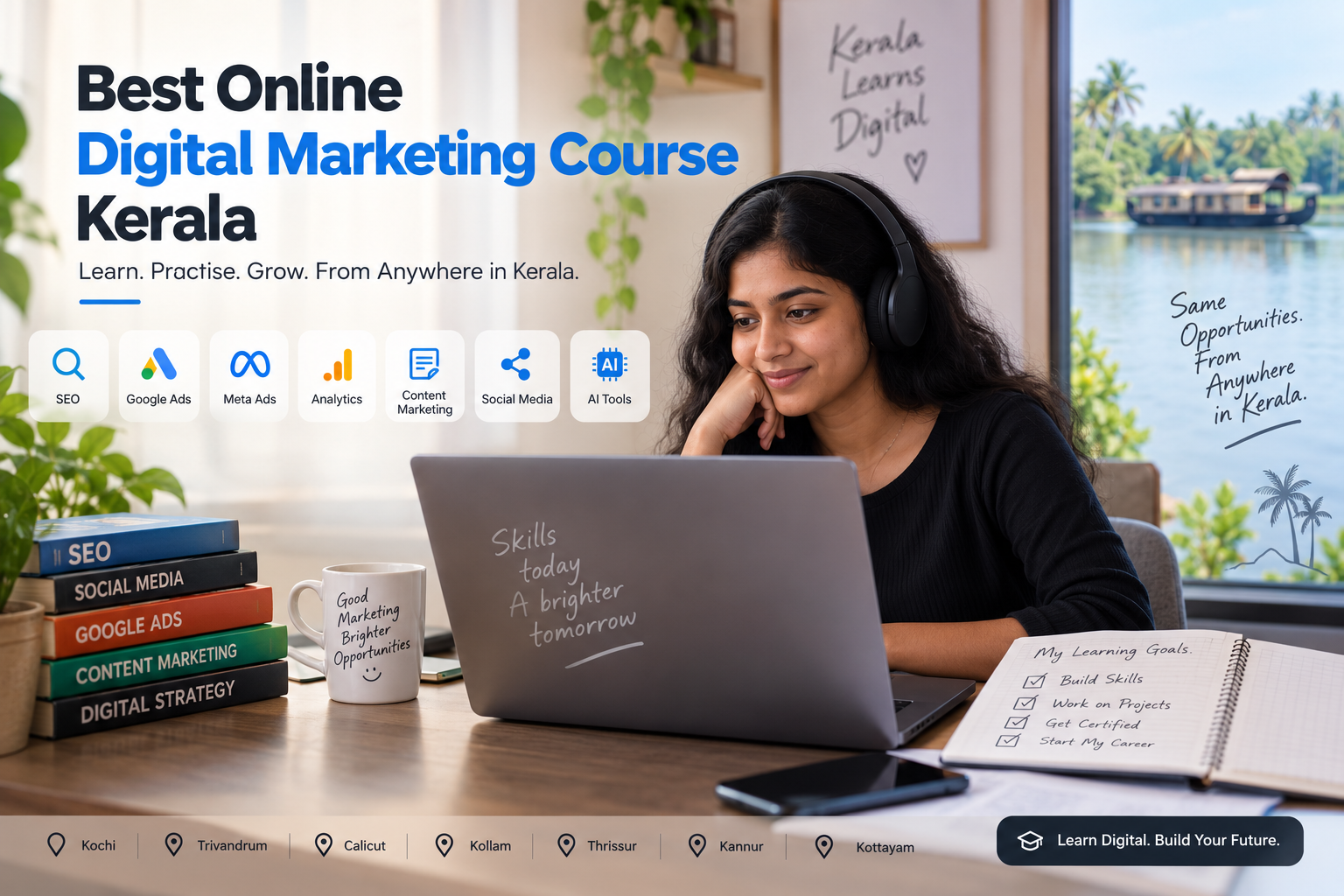
Best Online Digital Marketing Course Kerala: A Practical Guide for Beginners
Sep 17, 2026
Best Online Digital Marketing Course Kerala: A Practical Guide for Beginners
Digital marketing has become an important skill for businesses, freelancers, students and professionals across Kerala. A local business may need Google visibility, a startup may need paid advertising, and an individual creator may need social media and content marketing.
Because of this growing demand, many people search for the best online digital marketing course Kerala before choosing where to study.
But finding a suitable course is not simply about choosing the institute with the biggest advertisement or the longest list of modules. The more important question is:
What will you actually be able to do after completing the course?
A good online digital marketing programme should help you understand how different marketing channels work, practise the tools, analyse results and apply what you learn to realistic business situations.
This guide explains what students in Kerala should look for when comparing online digital marketing courses.
What Is Digital Marketing?
Digital marketing is the process of promoting products, services or brands through digital channels.
Some of the major areas include:
- Search Engine Optimization (SEO)
- Search Engine Marketing (SEM)
- Google Ads
- Meta Ads
- Social media marketing
- Content marketing
- Email marketing
- Affiliate marketing
- Website and landing-page optimization
- Web analytics
- Conversion optimization
- Local SEO
- Performance marketing
These areas are connected rather than completely separate.
For example, a business selling products online might use SEO to attract organic visitors, Google Ads to reach people actively searching, Instagram content to build awareness and analytics tools to understand which campaigns are producing results.
That is why learning the overall digital marketing ecosystem is often more useful than learning one advertising platform in isolation.
Why Are Online Digital Marketing Courses Popular in Kerala?
Online learning has changed how students and professionals can access digital marketing education.
A student living in Kochi, Thrissur, Kozhikode, Kannur or another part of Kerala does not necessarily have to travel every day to attend a physical classroom.
Online learning can be particularly useful for:
- College students
- Recent graduates
- Working professionals
- Entrepreneurs
- Freelancers
- Small-business owners
- People changing careers
- Students who live away from major cities
The Kerala government's skill-development ecosystem also includes online digital-marketing programmes covering areas such as SEO, social media marketing, online advertising, analytics, website creation and lead generation.
However, online does not automatically mean effective.
The quality of the learning experience depends heavily on the course structure, trainer interaction, practical work and the student's own consistency.
What Should You Look for in the Best Online Digital Marketing Course Kerala?
There is no single course that is automatically the best choice for every learner.
A beginner and a working marketing professional may have completely different requirements.
Instead of relying on the word "best", compare courses using the following factors.
1. Live Classes vs Recorded Videos
One of the first things to check is whether the course is live, recorded or a combination of both.
Recorded videos can be convenient because students can learn at their own pace. However, beginners may sometimes struggle when they encounter a problem and have nobody to ask immediately.
Live classes can provide:
- Real-time interaction
- Question-and-answer sessions
- Screen sharing
- Demonstrations
- Trainer feedback
- Discussion of practical examples
For students who prefer classroom-style learning from home, a live interactive course can be particularly useful.
The online-course page associated with this topic currently highlights live interactive sessions, screen-sharing practicals and flexible online learning formats.
2. Check the Syllabus Carefully
Do not choose a course only because it says "digital marketing".
Open the complete syllabus and check what is actually included.
A well-rounded beginner-level programme may cover:
Digital Marketing Fundamentals
Understanding customers, marketing channels, buyer journeys, funnels and basic strategy.
SEO
Keyword research, on-page SEO, technical SEO, off-page SEO, local SEO and performance measurement.
Google Ads
Search campaigns, keyword targeting, ad copy, bidding, budgets, conversion tracking and campaign analysis.
Social Media Marketing
Content planning, audience research, social media strategy and platform-specific marketing.
Meta Advertising
Campaign objectives, audiences, creatives, budgets, bidding, tracking and performance analysis.
Content Marketing
Research, content planning, writing, distribution and optimization.
Analytics
Understanding traffic, conversions, engagement, campaign performance and important marketing metrics.
Courses in Kerala vary considerably in how deeply they cover these areas. For example, official skill programmes and private training providers currently list combinations of SEO, SEM, social media, content, analytics, advertising and website-related skills.
3. Practical Training Matters More Than a Long Module List
Imagine learning Google Ads entirely through slides.
You may understand what CPC, CTR and conversion rate mean, but that does not necessarily mean you can create and analyse a campaign.
Practical training should allow you to work with tools and situations that resemble real marketing work.
Look for opportunities to practise:
- Keyword research
- SEO audits
- Competitor analysis
- Website optimization
- Google Ads campaign creation
- Meta Ads campaign planning
- Audience research
- Content creation
- Analytics reporting
- Landing-page analysis
- Campaign optimization
The goal is not simply to finish assignments.
The goal is to understand why a marketing decision is being made and how to measure its result.
4. Live Projects Can Make Learning More Realistic
A theoretical example might say:
"A company wants more leads. Create a Facebook campaign."
A practical project could require you to decide:
- Who is the target audience?
- What is the campaign objective?
- What offer should be promoted?
- Which creative should be used?
- What budget should be allocated?
- Which audience should be tested?
- What metrics should be monitored?
- What should be changed if the campaign performs poorly?
This type of thinking is important because digital marketing is not just about operating tools.
It is about making decisions based on data.
5. Check Whether the Course Teaches Analytics
Digital marketers need to understand numbers.
You do not need to become a mathematician, but you should understand common marketing metrics such as:
- Impressions
- Reach
- Frequency
- CTR
- CPC
- CPM
- CPA
- Conversion rate
- Cost per lead
- ROAS
- ROI
For example:
CTR = Clicks ÷ Impressions × 100
If an advertisement receives 100 clicks from 10,000 impressions:
CTR = 100 ÷ 10,000 × 100 = 1%
Learning these metrics helps you understand whether a campaign is generating attention, traffic or actual business results.
Analytics is also included in several structured digital-marketing programmes available in Kerala.
6. SEO Should Go Beyond Keyword Placement
SEO has changed significantly.
A modern SEO course should ideally introduce learners to multiple areas rather than focusing only on inserting keywords into articles.
Important topics include:
- Keyword research
- Search intent
- On-page SEO
- Technical SEO
- Internal linking
- Content optimization
- Backlinks
- Local SEO
- Structured data
- Page experience
- Search performance analysis
Students should also understand that search engines are increasingly presenting direct answers and richer search experiences.
This makes it useful to understand concepts such as Answer Engine Optimization (AEO) and how content can be structured to clearly answer user questions.
Some current Kerala digital-marketing programmes have already started incorporating AEO, GEO and AI-related marketing topics into their curricula.
7. Understand AEO and GEO
Traditional SEO focuses heavily on visibility in search results.
AEO focuses on making information useful and understandable for systems that provide direct answers.
GEO, commonly used to mean Generative Engine Optimization, focuses on improving the likelihood that useful information about a brand, topic or business can be surfaced in AI-generated search experiences.
For a digital marketer, this means content should be:
- Clear
- Well structured
- Factual
- Helpful
- Easy to understand
- Supported by trustworthy information
- Organized around real user questions
This is particularly relevant when creating blogs, FAQs, service pages and location-based content.
8. Look for Local SEO Training
Local SEO is particularly relevant for businesses serving specific locations.
Consider a bakery in Kochi, a clinic in Thrissur or a tuition centre in Kozhikode.
Their marketing strategy may depend heavily on searches containing local intent.
A digital marketing learner should understand concepts such as:
- Google Business Profile
- Local keyword research
- Local citations
- Reviews
- Location pages
- NAP consistency
- Local landing pages
- Local search intent
This can be an important skill for freelancers and agency professionals working with small and medium-sized businesses in Kerala.
9. AI Is Becoming Part of Digital Marketing
Artificial intelligence is increasingly being used for marketing tasks such as:
- Content research
- Idea generation
- Keyword analysis
- Ad-copy variations
- Customer research
- Data analysis
- Workflow automation
- Reporting
- Image and video ideation
But learning AI tools should not replace learning marketing fundamentals.
A person who knows how to generate 50 ad copies with AI but cannot identify the correct audience or campaign objective may still produce poor marketing.
A useful course should explain where AI can assist a marketer and where human judgement is still necessary.
Current Kerala programmes increasingly include AI tools and AI-assisted marketing within their curricula, reflecting this shift in the field.
10. Certification Is Useful, But It Is Not Everything
A certificate can demonstrate that you completed a programme.
However, employers and clients may also want evidence that you can actually perform marketing tasks.
For this reason, try to build a portfolio alongside your certificate.
A beginner portfolio could contain:
- SEO audit
- Keyword research document
- SEO article
- Google Ads campaign plan
- Meta Ads campaign structure
- Social media content calendar
- Competitor analysis
- Landing-page analysis
- Marketing strategy
- Analytics report
A portfolio gives you something concrete to discuss during interviews.
Who Can Learn Digital Marketing Online?
You do not necessarily need a marketing degree to start learning digital marketing.
Online programmes can be relevant to:
Students
Students can use digital marketing skills to build practical experience before graduation.
Graduates
Graduates from different educational backgrounds can explore areas such as SEO, social media, paid advertising, content or analytics.
Working Professionals
Professionals can use online learning to develop additional marketing skills without leaving their existing job.
Business Owners
Entrepreneurs can learn enough digital marketing to understand how their agency, freelancer or internal marketing team is working.
Freelancers
Freelancers can develop specialized services such as SEO, social media management, Google Ads or content marketing.
Government-supported digital-marketing programmes in Kerala also list graduates, students and other eligible learners among their target groups, although eligibility varies by programme.
How Long Does an Online Digital Marketing Course Take?
There is no universal duration.
The length depends on the syllabus and depth of training.
Some programmes are structured around approximately 120 hours of learning, while private programmes can run for several months with different levels of practical training.
Instead of asking only:
"How many months is the course?"
also ask:
"How many hours are live classes, how much practical work is included, and what will I be able to create by the end?"
A shorter course with focused practical work can be more useful for one learner, while another learner may benefit from a longer programme with deeper specialization.
How Much Does an Online Digital Marketing Course Cost in Kerala?
Fees vary depending on:
- Course duration
- Number of modules
- Live vs recorded classes
- Trainer experience
- Practical projects
- Mentorship
- Certification
- Placement assistance
- Specialization
- Learning resources
For example, Kerala's publicly listed digital-marketing programmes have appeared at different price points and formats, showing that there is no single standard course fee.
Therefore, compare what is included in the fee rather than comparing price alone.
Online vs Offline Digital Marketing Course
Both learning formats have advantages.
| Factor | Online | Offline | | ------------------ | ----------------------------------------- | -------------------------------------- | | Travel | No daily travel | Requires travel | | Flexibility | Usually higher | Depends on schedule | | Live interaction | Possible | Usually direct | | Learning location | Anywhere | Training centre | | Recorded access | Often available | Depends on institute | | Practical learning | Depends on course | Usually easier in physical labs | | Networking | Mostly online | Face-to-face opportunities | | Suitable for | Remote learners and working professionals | Students preferring classroom learning |
The important point is that online does not mean inferior and offline does not automatically mean better.
The teaching method, practical exposure and consistency of the learner matter more.
How to Choose a Digital Marketing Course in Kerala: A Simple Checklist
Before paying for a course, ask these questions:
Course Quality
- Is the syllabus updated?
- Are the classes live or recorded?
- Can I interact with the trainer?
- Are practical sessions included?
Practical Exposure
- Will I work on projects?
- Will I conduct SEO audits?
- Will I create campaign plans?
- Will I analyse marketing data?
Tools
- Will I get hands-on experience with Google Ads?
- Meta Ads?
- Analytics tools?
- SEO tools?
- WordPress?
- Design or content tools?
Career Preparation
- Is portfolio development included?
- Are mock interviews available?
- Is resume preparation covered?
- Is placement assistance clearly explained?
Flexibility
- Are weekday and weekend options available?
- Are recordings provided?
- What happens if I miss a class?
- How long will I have access to learning materials?
Asking these questions before enrolling can help avoid choosing a course based purely on advertising claims.
What Can You Do After Learning Digital Marketing?
Digital marketing includes several different career paths.
Depending on your interests and experience, you could explore roles such as:
- SEO Executive
- SEO Specialist
- Social Media Executive
- Social Media Manager
- Performance Marketing Executive
- Google Ads Specialist
- Meta Ads Specialist
- Content Writer
- Content Strategist
- Digital Marketing Executive
- Digital Marketing Analyst
- Email Marketing Specialist
- Freelance Digital Marketer
You do not have to master every specialization immediately.
A practical approach is to learn the fundamentals first and then develop deeper expertise in one or two areas.
Frequently Asked Questions
What is the best online digital marketing course Kerala?
There is no universally best course for every student. The right choice depends on your goals, budget, schedule, preferred learning format and the practical skills you want to develop. Compare the syllabus, live interaction, projects, tools, mentorship and career support before enrolling.
Is an online digital marketing course useful for beginners?
Yes. Beginners can learn digital marketing online if the programme starts with fundamentals and provides sufficient practical guidance and trainer interaction.
Can I learn digital marketing without a marketing degree?
Yes. Many digital-marketing programmes accept learners from different educational backgrounds. Specific eligibility requirements depend on the course.
Is coding required to learn digital marketing?
Most digital marketing roles do not require advanced programming. However, basic knowledge of HTML, websites, tracking and technical concepts can be useful, particularly for SEO and analytics.
Can I learn digital marketing from home in Kerala?
Yes. Online programmes allow students from different parts of Kerala to attend classes remotely. Live online learning can also provide real-time demonstrations and doubt-clearing sessions.
How long does it take to learn digital marketing?
It depends on the depth of the programme and your learning schedule. Some structured programmes are around 120 hours, while other courses run for several months.
Is a certificate enough to get a digital marketing job?
A certificate can support your profile, but practical skills, portfolio projects, communication and the ability to demonstrate what you have learned can also matter during recruitment.
Should I choose a live or recorded online course?
If you are a beginner and expect to have many questions while learning tools, live interactive classes may provide more immediate guidance. Recorded courses can be useful when flexibility and self-paced learning are your priorities.
Final Thoughts
Searching for the *best online digital marketing course Kerala* is only the first step.
The more useful approach is to ask what you want to achieve from the course.
If your goal is employment, look for practical projects and portfolio development. If you are interested in freelancing, pay attention to client handling, reporting and service delivery. If you own a business, focus on strategy, advertising, SEO and analytics.
Digital marketing is a broad field, and the tools will continue to change. Google Ads interfaces change, social platforms introduce new advertising features, search behaviour evolves and AI continues to influence how people discover information.
Because of that, the most valuable course is not necessarily the one with the longest syllabus.
It is the one that helps you understand the fundamentals, practise real marketing tasks, analyse results and continue learning after the course ends.
For anyone in Kerala comparing online options, the best starting point is to compare the curriculum, teaching format, practical exposure, trainer interaction, projects, tools, certification and career support before making a decision.
Talk to Our Career Expert
Unbiased Career Guidance
Have questions after reading this? Book a free call and our counselors will guide you.
© 2026 DigitalMarketingCourseKerala.com
Need Course Guidance?
Talk to our expert