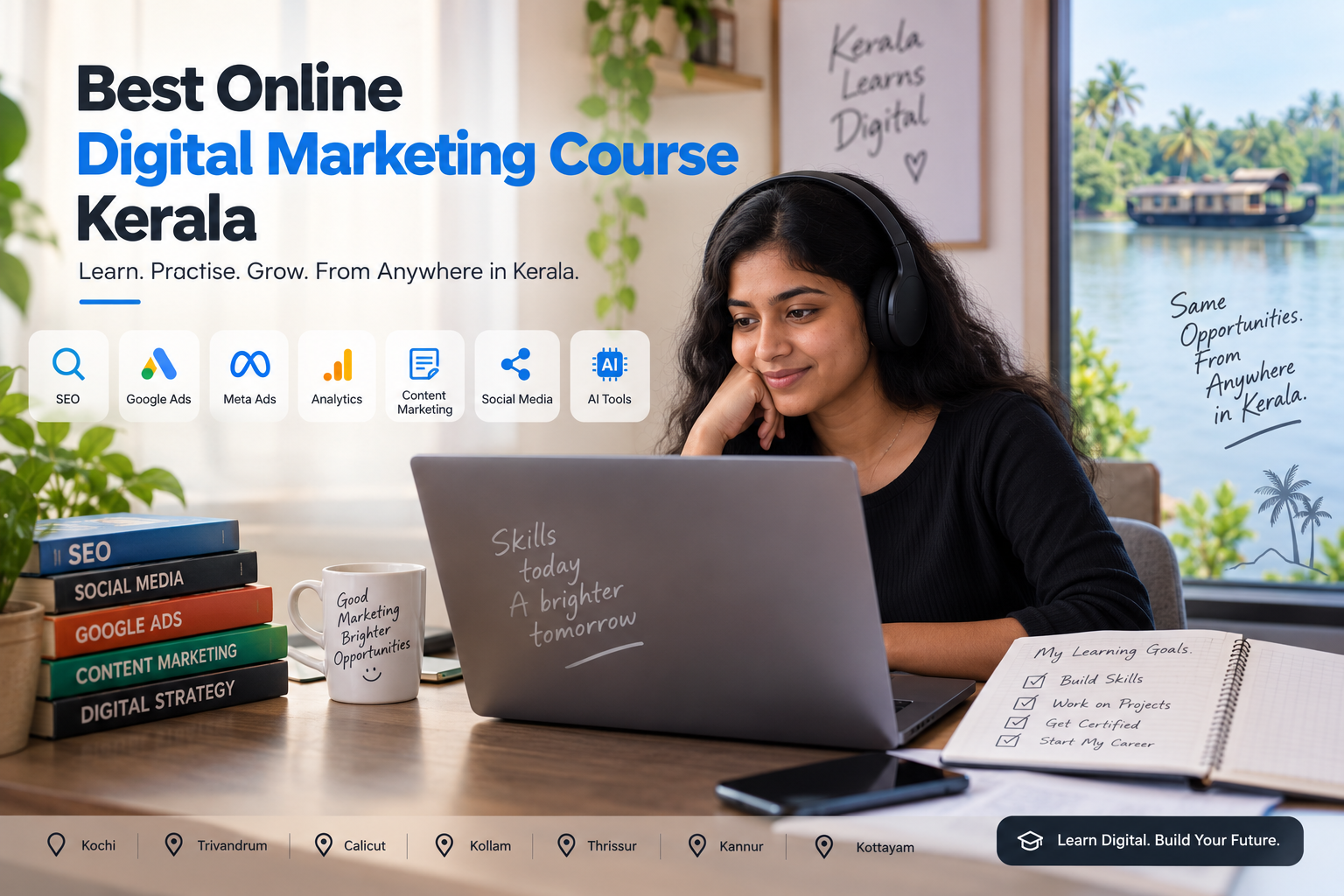
Learn Digital Marketing Online in Kerala: Courses, Skills and Career Opportunities
Sep 21, 2026
Digital marketing has become an important skill for businesses, professionals, students and entrepreneurs. As more customers discover products and services through search engines, social media, websites and online platforms, businesses need people who understand how digital channels work together.
For learners in Kerala, online education has made it possible to learn digital marketing without relocating to a major city or travelling to a training centre every day. But with many courses available online, choosing the best online digital marketing course Kerala learners can take is not always straightforward.
The right course is not necessarily the one with the longest syllabus or the most certificates. What matters is whether the course teaches practical digital marketing concepts, gives learners opportunities to practise tools and explains how different marketing channels contribute to a business.
This guide explains what to look for in an online digital marketing course, what you can learn, who can benefit from it and how to evaluate different options.
What Is Digital Marketing?
Digital marketing is the process of promoting products, services, brands or businesses through digital channels.
Some of the major areas include:
- Search Engine Optimisation (SEO)
- Search Engine Marketing (SEM)
- Google Ads
- Social media marketing
- Meta Ads
- Content marketing
- Email marketing
- Affiliate marketing
- Influencer marketing
- Web analytics
- Conversion optimisation
- Performance marketing
These areas are connected rather than completely separate.
For example, a business might use SEO to attract organic traffic, Google Ads to reach users with commercial search intent, social media to build awareness and email marketing to maintain relationships with existing customers.
Understanding how these channels work together is one of the foundations of digital marketing.
Why Choose an Online Digital Marketing Course?
Online learning can be useful for people who need flexibility.
Instead of travelling to a classroom every day, learners can attend classes from home using a laptop and an internet connection. Live online courses can also include screen sharing, discussions and real-time doubt clearing.
The effectiveness of online learning depends heavily on how the course is delivered. A completely self-paced video library and a live interactive programme can provide very different learning experiences.
A good online learning environment should ideally provide:
- Live or interactive sessions
- Practical demonstrations
- Screen-sharing sessions
- Assignments and projects
- Opportunities to ask questions
- Access to relevant digital marketing tools
- Regular feedback
- Updated course material
Google itself provides online learning through Skillshop, where learners can access training for products such as Google Ads and Google Analytics and complete courses at their own pace.
What Should You Learn in an Online Digital Marketing Course?
A comprehensive course should introduce learners to the major areas of digital marketing instead of focusing on only one platform.
1. Search Engine Optimisation
SEO helps websites improve their visibility in organic search results.
A beginner-level SEO module should explain:
- Keyword research
- Search intent
- On-page SEO
- Technical SEO
- Off-page SEO
- Link building
- Internal linking
- Meta titles and descriptions
- Image optimisation
- Local SEO
- SEO audits
- Search performance analysis
SEO is particularly useful for understanding how people discover websites through search engines.
2. Google Ads
Google Ads introduces learners to paid search and other Google advertising formats.
Important concepts include:
- Campaign structure
- Keyword research
- Search campaigns
- Ad copy
- Bidding strategies
- Conversion tracking
- Campaign optimisation
- Performance measurement
Google's official Skillshop currently provides learning paths covering Google Ads Search, Display, Video, Shopping and Measurement.
3. Social Media Marketing
Social media marketing involves using platforms such as Instagram, Facebook, LinkedIn and other relevant channels to communicate with audiences.
Learners should understand:
- Content planning
- Audience research
- Organic social media
- Social media calendars
- Engagement
- Community management
- Content formats
- Social media analytics
The goal is not simply to post every day. A marketer should understand why particular content is being created and what business objective it supports.
4. Meta Advertising
Meta Ads can be an important part of paid social media marketing.
A practical course may cover:
- Campaign objectives
- Campaign structure
- Audience targeting
- Custom audiences
- Lookalike audiences
- Budgeting
- Ad creatives
- Ad copy
- Lead generation
- Website conversions
- Retargeting
- Campaign metrics
Students should also learn how to interpret metrics instead of simply memorising them.
For example, CTR, CPC, CPM, CPL, CPA and ROAS can help marketers understand different parts of campaign performance.
5. Content Marketing
Content is an important part of digital marketing because businesses need useful information to attract and engage potential customers.
Content marketing may include:
- Blog articles
- Social media posts
- Videos
- Infographics
- Guides
- Case studies
- Email content
- Landing-page content
A good course should teach students to create content based on audience needs and search intent rather than simply filling pages with keywords.
6. Analytics and Measurement
Digital marketing decisions should be supported by data.
Learners should become familiar with concepts such as:
- Traffic
- Engagement
- Conversions
- Conversion rate
- Acquisition
- User behaviour
- Campaign attribution
- ROI
- ROAS
Google's Skillshop includes learning resources for Google Analytics and measurement, alongside its Google Ads training.
What Makes an Online Digital Marketing Course Useful?
When comparing the best online digital marketing course Kerala options, look beyond the course title.
Here are some practical questions to ask.
Is the course practical?
Digital marketing is tool-based. Reading about Google Ads, SEO or Meta Ads is different from actually working with the platforms.
Look for courses that include demonstrations, assignments and practical exercises.
Are the classes live?
Live classes can make it easier to ask questions and understand difficult concepts.
However, recorded lessons can also be useful for revision. An online programme that combines live learning with recorded resources can provide flexibility for different learning styles.
Does the syllabus reflect current practices?
Digital marketing platforms change frequently.
Google's Skillshop, for example, regularly provides updated learning paths and product-specific training.
A course should therefore avoid relying entirely on outdated screenshots, techniques or strategies.
Does the course include projects?
Projects allow students to apply what they learn.
A project might involve:
- Creating an SEO strategy for a website
- Conducting keyword research
- Building a Google Ads campaign structure
- Creating a social media plan
- Preparing a Meta Ads campaign
- Analysing campaign performance
- Preparing a digital marketing report
These activities can help learners understand how marketing decisions are made in real situations.
Is Certification Important?
Certification can be useful, but it should not be the only reason to select a course.
Google provides certifications through Skillshop for areas such as Google Ads. Certifications are awarded after completing the relevant assessment requirements.
At the same time, an institute certificate and a platform certification serve different purposes.
An institute certificate generally shows that you completed a particular training programme, while a platform certification can demonstrate knowledge of a specific advertising or analytics platform.
For employment, practical knowledge, communication skills, portfolio work and the ability to explain your work can also matter.
Who Can Learn Digital Marketing Online?
You do not need to be a computer programmer to start learning digital marketing.
Online digital marketing courses can be suitable for:
- College students
- Fresh graduates
- Working professionals
- Business owners
- Freelancers
- Entrepreneurs
- Marketing professionals
- Social media managers
- SEO beginners
- People changing careers
Students from different educational backgrounds can enter digital marketing because many of its core activities involve marketing strategy, communication, research, creativity and data interpretation.
Can Beginners Learn Digital Marketing Online?
Yes.
A beginner can start with the fundamentals and gradually move into specialised areas.
A simple learning path could be:
Digital Marketing Fundamentals → SEO → Social Media → Google Ads → Meta Ads → Analytics → Performance Marketing
You do not need to master every topic at the same time.
Once you understand the basics, you can identify the areas you enjoy and develop deeper expertise in them.
How Long Does It Take to Learn Digital Marketing?
There is no fixed amount of time required to learn digital marketing.
The basics can be covered in a few months, while becoming confident with campaign management, analytics and optimisation requires continued practice.
For example, a beginner could spend the first few weeks learning fundamentals, followed by practical work in SEO, paid advertising, social media and analytics.
The important part is consistency.
Watching 50 hours of videos without practising may be less useful than learning a smaller amount of material and applying it through projects.
Online vs Offline Digital Marketing Course
Both formats have advantages.
| Factor | Online Course | Offline Course | | ------------------ | -------------------------------------- | ------------------------- | | Location | Learn from anywhere | Requires travel | | Flexibility | Usually higher | Depends on class schedule | | Interaction | Live sessions, chat and screen sharing | Face-to-face interaction | | Commute | Not required | Required | | Recorded lessons | Often available | Depends on institute | | Networking | Online community | Physical classroom | | Practical learning | Depends on course structure | Depends on institute |
There is no universal answer about which format is better.
The more important question is whether the learning environment suits your schedule and whether you get enough practical exposure.
What Career Options Can Digital Marketing Skills Support?
Digital marketing covers several specialised roles.
Depending on your skills and experience, possible career paths include:
SEO Executive
Focuses on organic search visibility, keyword research, technical SEO, content optimisation and link-building activities.
PPC Executive
Works with paid advertising campaigns, keyword research, ad creation, bidding and performance analysis.
Social Media Executive
Manages social media content, calendars, engagement and platform-specific strategies.
Performance Marketing Executive
Works with paid campaigns and focuses heavily on measurable outcomes such as leads, conversions and revenue.
Digital Marketing Executive
Works across multiple areas of digital marketing and may coordinate SEO, social media, paid advertising, content and analytics.
Freelance Digital Marketer
Experienced professionals can provide digital marketing services directly to businesses and clients.
The actual responsibilities depend on the company, role and level of experience.
What Should You Check Before Joining an Online Course in Kerala?
Before choosing among different options for the best online digital marketing course Kerala search, create a simple checklist.
Course curriculum
Check whether the syllabus covers the areas you actually want to learn.
Practical training
Find out whether you will work on real tools, assignments or simulated business projects.
Class format
Ask whether classes are live, recorded or a combination of both.
Trainer experience
Look at the trainer's practical industry background and teaching experience.
Course duration
A longer course is not automatically better. Compare the actual learning hours and curriculum.
Certification
Check what certificates or platform certifications are included and who issues them.
Support
Find out whether students can ask questions after class and receive feedback on assignments.
Portfolio opportunities
Projects can help you demonstrate your skills when applying for internships, jobs or freelance work.
Frequently Asked Questions
What is the best online digital marketing course in Kerala?
There is no single course that is the best choice for every learner. The right course depends on factors such as curriculum, teaching format, practical training, trainer experience, certification, flexibility and career objectives.
Can I learn digital marketing from home?
Yes. Digital marketing can be learned online using a computer, internet connection and access to relevant tools. Live online classes can also provide interaction with trainers and other learners.
Is an online digital marketing course suitable for beginners?
Yes. Beginners can start with digital marketing fundamentals and gradually learn areas such as SEO, social media, Google Ads, Meta Ads and analytics.
Do I need coding knowledge to learn digital marketing?
No. Coding is not a core requirement for learning most areas of digital marketing. However, basic technical knowledge can be helpful when working with websites, tracking, analytics and technical SEO.
Is digital marketing a good skill for fresh graduates?
Digital marketing can provide several entry-level specialisations, including SEO, social media, PPC and digital marketing executive roles. The opportunities available to a graduate depend on their skills, portfolio, location, employer and experience.
Can I learn Google Ads and SEO together?
Yes. In fact, learning both can help you understand the difference between paid and organic search visibility. Google also provides separate learning paths for Google Ads and Google Analytics through Skillshop.
Are Google certifications useful?
Google certifications can demonstrate proficiency in specific Google products and advertising areas. They can be useful as part of a broader portfolio of skills and practical experience.
Final Thoughts
Choosing the *best online digital marketing course Kerala* learners can take is less about finding a course with the biggest list of features and more about finding a learning programme that matches your goals.
Look for a course that combines fundamentals, practical training, current tools, projects, analytics and continuous learning.
Online learning can be particularly useful for students, professionals and business owners in Kerala who want to develop digital marketing skills without being limited by classroom location.
Most importantly, treat the course as a starting point. Digital marketing platforms continue to evolve, so the ability to research, test, analyse results and keep learning is just as important as completing the course itself.
Talk to Our Career Expert
Unbiased Career Guidance
Have questions after reading this? Book a free call and our counselors will guide you.
© 2026 DigitalMarketingCourseKerala.com
Need Course Guidance?
Talk to our expert