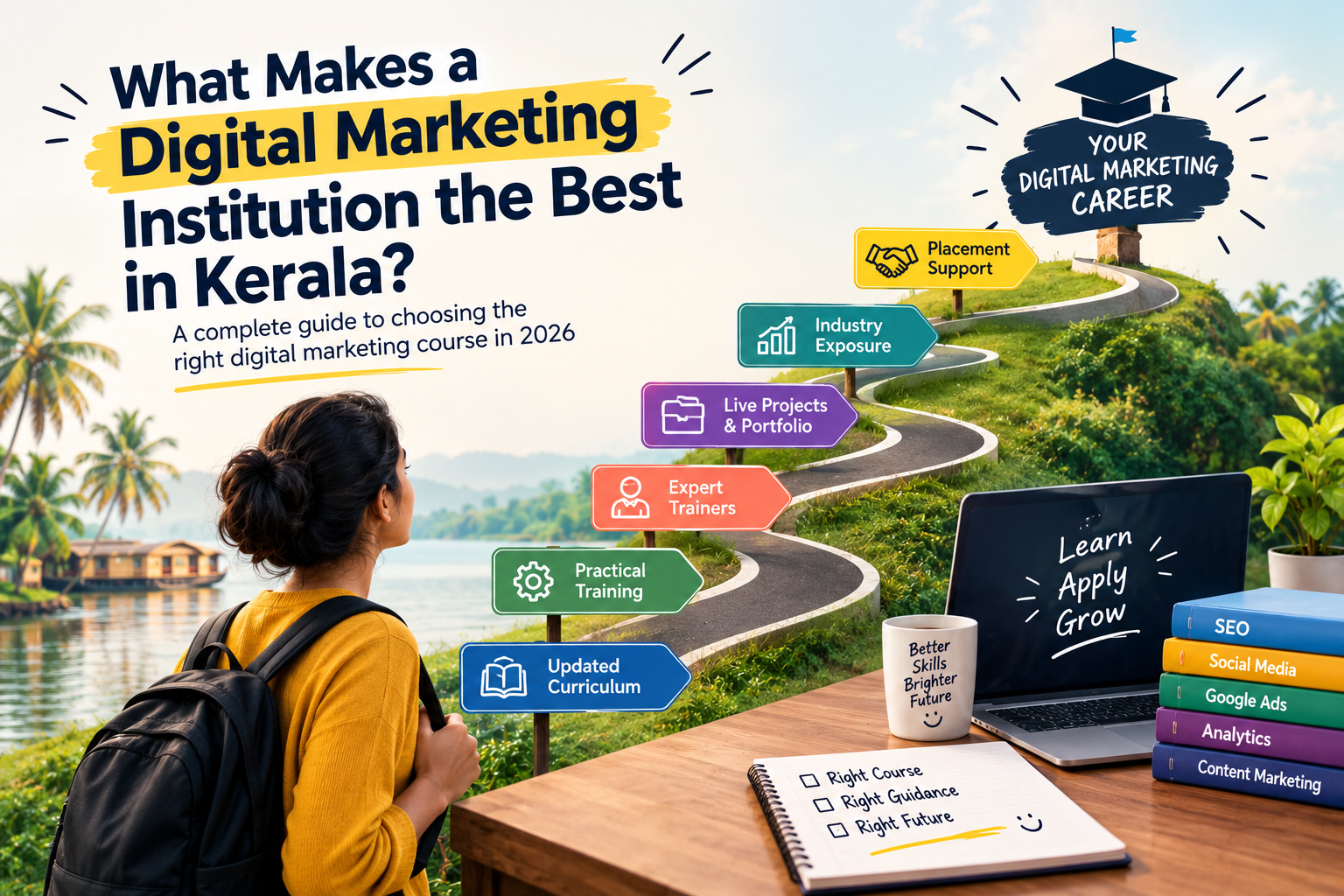
What Makes the Best Digital Marketing Institution in Kerala?
Sep 09, 2026
Searching for the best digital marketing institution in Kerala can be surprisingly confusing.
You may find institutes promising industry-ready training, certifications, practical projects, placement assistance, expert trainers, and dozens of modules. But when every institution uses similar words, how do you determine which one is actually worth your time and money?
The answer is not simply the number of modules, the course fee, the number of certificates, or how attractive the institute's advertisements look.
A good digital marketing institution should help you develop something much more valuable:
the ability to understand a marketing problem, choose the right channel, execute a strategy, measure the result, and improve it.
This guide explains what students should evaluate before choosing a digital marketing institution in Kerala in 2026.
Quick Answer: What Makes a Digital Marketing Institution the Best in Kerala?
There is no single institution that can objectively be called the best for every student.
The right choice depends on factors such as:
- Your career goal
- Learning format
- Course syllabus
- Practical exposure
- Trainer expertise
- Industry relevance
- Access to marketing tools
- Analytics training
- Portfolio development
- Mentorship
- Course updates
- Placement support
The most important question is not:
“Which institution is the best?”
Instead, ask:
“Which institution can give me the practical skills I need for the type of digital marketing work I want to do?”
That shift in thinking makes course comparison much easier.
Institution vs Course: Why the Difference Matters
A common mistake is to compare only course names.
For example:
Digital Marketing Course
can mean very different things at different institutions.
One program may focus primarily on theory and recorded lessons.
Another may include website projects, SEO audits, Google Ads campaigns, Meta Ads, analytics, content strategy, and portfolio development.
So when searching for the best digital marketing institution in Kerala, evaluate both:
The institution → trainers, learning environment, support and credibility.
The course → syllabus, practical training, projects and outcomes.
A strong institution with an outdated course may not be the right choice.
Similarly, a good syllabus without proper guidance may not provide enough learning value.
1. A Strong Curriculum Should Reflect How Digital Marketing Works Today
Digital marketing is not a fixed subject.
Search engines, advertising platforms, analytics tools, social networks, and AI technologies continuously evolve.
Therefore, an institution should regularly review its curriculum.
A comprehensive beginner-to-intermediate program may include:
Digital Marketing Fundamentals
- Digital customer journey
- Marketing funnel
- Buyer personas
- Customer intent
- Digital strategy
- Marketing objectives
- KPIs
- Conversion concepts
SEO
- Keyword research
- Search intent
- On-page SEO
- Technical SEO
- Off-page SEO
- Local SEO
- Content optimization
- Internal linking
- Structured data
- Core Web Vitals
- Search Console
Paid Advertising
- Google Ads
- Search campaigns
- Keyword match types
- Negative keywords
- Ad assets
- Bidding strategies
- Conversion tracking
- Meta Ads
- Audience targeting
- Retargeting
- Campaign optimization
Analytics
- Google Analytics
- Google Tag Manager
- Search Console
- UTM tracking
- Events
- Conversions
- Attribution
- Reporting
Social Media
- Content strategy
- Organic social media
- Paid social advertising
- Audience research
- Creative testing
- Social analytics
Content Marketing
- Content strategy
- Blog writing
- Landing pages
- Social content
- Video content
- Content distribution
- Search-intent-based content
AI for Marketing
AI should ideally be taught as a marketing productivity and decision-support tool, rather than simply as a content generator.
Useful applications include:
- Research
- Content ideation
- Competitor analysis
- Ad-copy variations
- Data analysis
- Reporting
- Workflow automation
- SEO research
- Personalization
2. Practical Training Should Be More Than Watching Demonstrations
One of the easiest ways to identify the difference between theoretical and practical training is to ask:
“What will I actually do during the course?”
Watching an instructor create a campaign is not the same as creating one yourself.
A practical learning environment could involve students:
- Building a website
- Performing keyword research
- Conducting SEO audits
- Creating content briefs
- Setting up Google Ads campaigns
- Developing Meta Ads strategies
- Creating conversion-tracking plans
- Analysing campaign data
- Preparing marketing reports
- Presenting optimization recommendations
The student should gradually move from:
Watching → Doing → Measuring → Analysing → Optimising
That learning cycle is much more valuable than simply completing lessons.
3. Real Projects Matter More Than the Number of Certificates
Certificates can be useful as proof that you completed a program.
But they do not automatically demonstrate that you can perform digital marketing tasks.
Imagine two candidates applying for an entry-level SEO position.
Candidate A
Has completed several certificates but has never conducted a complete SEO audit.
Candidate B
Has fewer certificates but can demonstrate:
- A technical SEO audit
- Keyword research
- Keyword mapping
- On-page recommendations
- Internal-linking strategy
- Competitor analysis
- A content plan
Candidate B has something concrete to discuss during an interview.
This is why students should ask institutions:
“What projects will I have in my portfolio after completing the course?”
4. Trainers Should Understand Marketing, Not Just the Tools
Knowing how to use an advertising platform is only one part of digital marketing.
A good trainer should be able to explain:
Why are we targeting this audience?
Why did this keyword perform better?
Why is the conversion rate falling?
Why should this landing page be changed?
Why should we increase or decrease the budget?
Why is organic traffic not converting?
These questions require marketing thinking rather than simply platform knowledge.
When evaluating an institution, look at the trainer's:
- Industry experience
- Areas of specialization
- Practical campaign experience
- Teaching experience
- Ability to explain concepts
- Understanding of current platform changes
A trainer's job should not be limited to demonstrating software interfaces.
5. Analytics Should Be Part of the Core Curriculum
A surprisingly common problem in digital marketing education is focusing heavily on campaign creation and not enough on measurement.
Suppose you spend ₹10,000 on advertising.
You generate 200 clicks.
Is that successful?
Not necessarily.
You need to know:
- How many leads were generated?
- How many became customers?
- What was the cost per lead?
- What was the cost per acquisition?
- What revenue was generated?
- Which audience performed best?
- Which creative performed best?
- Which landing page converted better?
This is why analytics should not be treated as an optional module.
Students should learn to connect:
Traffic → Engagement → Conversion → Revenue → Optimization
6. Students Should Learn How to Read Marketing Data
Learning the definition of a metric is not enough.
For example:
CTR = Click-through rate
Knowing this definition does not tell you what to do when CTR decreases.
A practical institution should teach students to interpret metrics in context.
For example:
High CTR + Low Conversion Rate
Possible areas to investigate:
- Search intent
- Landing page relevance
- Offer
- Audience quality
- Conversion tracking
- Page speed
Low CTR + Good Conversion Rate
Possible areas to investigate:
- Ad messaging
- Creative
- Targeting
- Keyword relevance
- Value proposition
This type of problem-solving is closer to actual digital marketing work.
7. SEO Training Should Go Beyond Keywords
SEO has changed significantly.
A course that teaches only:
Keyword research → write article → add backlinks
does not provide a complete understanding of modern SEO.
Students should understand:
- Search intent
- Technical accessibility
- Information architecture
- Internal linking
- Content quality
- Topical coverage
- Entities
- Structured data
- User experience
- Local search
- Search features
- AI-driven search experiences
They should also understand that SEO is not about manipulating one ranking factor.
It is about making useful information discoverable and accessible while aligning content with what people are actually trying to accomplish.
8. Local SEO Is Particularly Useful for Kerala Businesses
Kerala has a large number of location-dependent businesses.
Examples include:
- Restaurants
- Clinics
- Hotels
- Educational institutions
- Real-estate businesses
- Tourism businesses
- Home-service companies
- Retail stores
- Beauty and wellness businesses
Therefore, students interested in agency work should understand local search.
Important topics include:
- Google Business Profile
- Local keyword research
- Reviews
- NAP consistency
- Local landing pages
- Local citations
- Location-based content
- Map visibility
For example, a business targeting customers in Kochi may need a different local strategy from a business targeting Thiruvananthapuram or Kozhikode.
9. Google Ads Training Should Include Optimization
Launching a campaign is only the beginning.
A student should understand what happens after the campaign starts.
For example:
Search terms → Keyword decisions → Negative keywords → Ad relevance → Landing page → Conversion data → Optimization
A practical Google Ads curriculum should cover:
- Campaign structure
- Keyword research
- Match types
- Negative keywords
- Ad creation
- Assets
- Bidding
- Budget
- Conversion tracking
- Search-term analysis
- Quality Score
- CPA
- Conversion value
- ROAS
- Campaign optimization
Students should also learn that a campaign with a high number of clicks is not automatically successful.
10. Meta Ads Should Be Taught as a System
Similarly, Meta Ads should not be taught as simply:
Create campaign → choose audience → upload image → publish
Students should understand the relationship between:
Objective → Audience → Creative → Placement → Landing experience → Tracking → Conversion → Optimization
Topics worth learning include:
- Campaign structure
- Audience research
- Custom audiences
- Lookalike audiences
- Retargeting
- Creative testing
- Placements
- Pixel
- Conversions API concepts
- Attribution
- CPM
- CTR
- CPC
- CPL
- CPA
- ROAS
This helps students understand what happens after an advertisement is published.
11. The Institution Should Teach Portfolio Building
A beginner often faces a difficult question:
“How can I get a digital marketing job when every job asks for experience?”
One practical answer is to build evidence of your ability while learning.
A good course can help students create portfolio projects such as:
SEO Portfolio Project
A complete website audit containing:
- Technical issues
- Keyword research
- Competitor analysis
- On-page recommendations
- Content opportunities
- Internal-linking recommendations
Google Ads Project
A campaign plan containing:
- Campaign objective
- Keyword research
- Ad groups
- Negative keywords
- Ad copy
- Budget assumptions
- Conversion strategy
- Optimization plan
Meta Ads Project
A campaign strategy containing:
- Audience
- Creative concepts
- Campaign structure
- Retargeting
- KPIs
- Optimization recommendations
Analytics Project
A report explaining:
- Traffic
- Acquisition
- Engagement
- Conversions
- Key findings
- Recommended actions
A portfolio gives employers something more meaningful to evaluate than a certificate alone.
12. Industry Tools Should Be Part of the Learning Process
Digital marketing involves a large ecosystem of tools.
Depending on the specialization, students may encounter tools such as:
- Google Search Console
- Google Analytics
- Google Tag Manager
- Google Ads
- Meta Ads Manager
- Keyword research platforms
- SEO auditing tools
- Website analytics tools
- Content research tools
- AI tools
The important point is not learning the maximum number of tools.
It is understanding which tool solves which problem.
An institution should teach tool selection rather than turning the course into a software checklist.
13. Placement Assistance Should Be Evaluated Carefully
“100% placement” is an attractive phrase, but students should understand exactly what it means.
Ask:
- Does placement mean interviews or guaranteed employment?
- How many companies are involved?
- What type of roles are available?
- Are internships included?
- Is interview preparation provided?
- Is resume support provided?
- Are mock interviews conducted?
- What happens after the course ends?
A transparent institution should clearly explain what its placement support includes.
Students should distinguish between:
Placement assistance
and
Guaranteed employment.
They are not the same thing.
14. Mentorship Can Be More Valuable Than Extra Modules
Suppose you learn SEO from 30 recorded lessons.
You complete an audit.
But you don't know whether your recommendations are correct.
This is where feedback matters.
Mentorship can help students understand:
- What they did incorrectly
- Why a particular approach is better
- How professionals solve problems
- How to improve reports
- How to interpret campaign data
- How to present work to clients
Therefore, when comparing institutions, ask:
“Who reviews my work?”
That question is often more useful than asking:
“How many modules are included?”
15. Course Updates Are Important in Digital Marketing
A digital marketing course created several years ago may contain outdated platform processes.
Google Ads changes.
Meta Ads changes.
Analytics tools change.
Search changes.
AI changes.
Therefore, ask:
When was the syllabus last updated?
Also ask whether students receive updated learning materials when important platform changes occur.
A strong learning environment should encourage continuous learning rather than treating the final class as the end of education.
16. Classroom Location Should Not Be Your Only Decision Factor
Students often search for:
- Digital marketing course in Kochi
- Digital marketing course in Trivandrum
- Digital marketing course in Kozhikode
- Digital marketing course in Thrissur
Location is certainly relevant if you prefer classroom learning.
But it should not be the deciding factor by itself.
A nearby institution with limited practical training may be less useful than a high-quality online or hybrid program with strong mentorship and projects.
Consider:
Learning quality > convenience of location
while still choosing a format that fits your personal circumstances.
17. What Should Students Look for in a Digital Marketing Institution in Kerala?
Here is a practical evaluation framework.
| Factor | What to Check | | ------------------ | ----------------------------------------------- | | Curriculum | Is it current and comprehensive? | | Practical training | Will you actually perform tasks? | | Projects | Can you build portfolio work? | | Trainers | Do they have relevant practical experience? | | Analytics | Is measurement taught properly? | | Tools | Will you work with industry-relevant platforms? | | Mentorship | Is your work reviewed? | | AI | Is AI taught practically and responsibly? | | Placement | Are claims clearly explained? | | Updates | Is the curriculum regularly revised? | | Flexibility | Does the format suit your schedule? | | Support | What happens when you have doubts? |
You can score each category from 1 to 5 and compare institutions objectively.
18. Red Flags to Watch Before Enrolling
Not every warning sign means an institution is poor, but these should prompt further questions.
Red Flag 1: Too many promises
Claims such as guaranteed high salaries or guaranteed employment should be examined carefully.
Red Flag 2: Certificate-heavy marketing
If most of the promotion focuses on certificates rather than skills and projects, ask what practical work is included.
Red Flag 3: Outdated curriculum
If important modern concepts are missing, ask when the syllabus was last updated.
Red Flag 4: No practical assignments
If the entire course consists of demonstrations, you may not develop execution skills.
Red Flag 5: No analytics
Marketing without measurement is incomplete.
Red Flag 6: No portfolio
If students finish the program without demonstrable work, ask how they are expected to demonstrate their skills to employers.
Red Flag 7: Tool-based learning only
Learning where to click is not the same as learning marketing strategy.
19. What Does a Good Digital Marketing Learning Journey Look Like?
Instead of trying to learn everything at once, a structured progression can be more effective.
Phase 1 — Foundations
Understand:
- Marketing fundamentals
- Customer journey
- Funnels
- Audience
- KPIs
Phase 2 — Core Channels
Learn:
- SEO
- Search advertising
- Social media
- Content marketing
- Email marketing
Phase 3 — Measurement
Learn:
- Analytics
- Tag management
- Conversion tracking
- Reporting
Phase 4 — Practical Execution
Work on:
- Websites
- Campaigns
- Content
- Audiences
- Reports
Phase 5 — Optimization
Learn how to answer:
“The campaign is not performing. What should I change, and why?”
Phase 6 — Specialization
Choose an area such as:
- SEO
- Performance marketing
- Social media
- Content
- Analytics
- Growth marketing
This approach creates a stronger foundation than trying to become an expert in every specialization simultaneously.
20. Should You Choose an Institution Based on Reviews?
Reviews can be useful, but don't rely on star ratings alone.
Look for patterns in reviews.
Pay attention to comments about:
- Teaching quality
- Practical sessions
- Trainer support
- Projects
- Doubt clearing
- Course updates
- Placement support
- Overall learning experience
Also remember that reviews represent individual experiences.
A better approach is to combine:
Reviews + curriculum + trainer background + practical projects + learning support
rather than using reviews as the only decision factor.
The Most Important Question to Ask
After comparing everything, ask yourself:
“If I remove the certificate from this course, would the skills and practical experience still make it valuable?”
If the answer is yes, you may have found a program worth considering.
If the answer is no, investigate further.
The value of digital marketing education should ultimately come from what you can do, not simply what you can claim to have completed.
Frequently Asked Questions
What is the best digital marketing institution in Kerala?
There is no universally best institution for every student. The right institution depends on curriculum quality, practical training, trainers, mentorship, tools, analytics, projects, and your specific career objective.
How do I choose a digital marketing institution in Kerala?
Compare institutions based on syllabus, practical exposure, trainers, projects, analytics training, industry tools, mentorship, placement support, course updates, and learning format.
Which city is best for digital marketing courses in Kerala?
Kochi, Thiruvananthapuram, Kozhikode, Thrissur, and other Kerala cities have digital marketing learning opportunities. Your choice should depend on course quality and your preferred learning format rather than location alone.
Is a certificate important for a digital marketing career?
A certificate can demonstrate course completion, but practical skills, portfolio projects, communication, analytical ability, and real-world understanding are also important.
How important are practical projects in a digital marketing course?
Very important. Projects allow students to apply concepts, identify problems, make decisions, analyse results, and build evidence of their skills.
Should a digital marketing course include AI?
AI is increasingly relevant to marketing workflows, so understanding practical AI applications can be useful. However, students should also learn fact-checking, strategy, data interpretation, originality, and human judgment.
Is digital marketing suitable for students from non-marketing backgrounds?
Yes. People from different academic backgrounds can learn digital marketing. The learning curve depends more on the individual's interest, practice, analytical ability, communication, and willingness to learn.
Is online or classroom digital marketing training better?
Neither format is automatically better. Choose based on instructor interaction, practical assignments, feedback, flexibility, mentorship, and your preferred learning style.
Can a digital marketing course guarantee a job?
A responsible institution should not treat course completion as an automatic guarantee of employment. Career outcomes depend on skills, portfolio, communication, interview performance, experience, and the job market.
Final Takeaway
The best digital marketing institution in Kerala is not necessarily the one with the largest advertisement, the longest syllabus, the highest fee, or the greatest number of certificates.
A better institution should help you develop a combination of:
Knowledge + Execution + Analytics + Problem-Solving + Portfolio + Continuous Learning
Before enrolling, investigate what happens after the classroom explanation.
Will you perform the task?
Will someone review your work?
Will you analyse the result?
Will you understand why something worked or failed?
Will you have something to show an employer or client?
Those questions reveal far more about the quality of a digital marketing institution than promotional claims alone.
Ultimately, don't choose an institution simply because it says it is the best digital marketing institution in Kerala.
Evaluate it. Compare it. Ask questions. Look at the learning process. Then decide.
Talk to Our Career Expert
Unbiased Career Guidance
Have questions after reading this? Book a free call and our counselors will guide you.
© 2026 DigitalMarketingCourseKerala.com
Need Course Guidance?
Talk to our expert